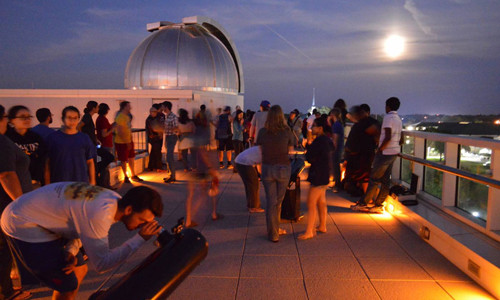
Austin College Observatory Star Party

Star Party Austin College Observatory

Star Party Austin College ObservatoryMembers of the local community are invited to see the wonders of the night sky, weather permitting, at an Austin College Observatory Star Party on Wednesday, October 12. The public is invited to observe stars through Adams Observatory and other telescopes on the roof of the College’s IDEA Center. Visitors may come and go from 8 p.m. to 10 p.m. The event is free but, due to space limitations, advance registration is requested at www.austincollege.edu/adams-observatory. Should weather conditions require cancellation, that news will be posted on the Austin College website after 3 p.m. on the day of the event.

The IDEA Center is located at 1108 E. Richards Street, and parking is available. Visitors should meet in the IDEA Center’s first-floor Page Atrium, just inside the building’s main entrance, to begin their star tour. The largest research telescope in North Texas will open the night sky to viewers. Austin College students also will set up small telescopes to allow visitors to explore craters on the Moon, distant star clusters, and the beautiful Orion Nebula.

Dr. David Baker, chair of the Austin College Physics Department and director of Adams Observatory, will coordinate the event. “When someone looks through the telescope and sees some of these objects in space, there’s a real sense of amazement,” said Dr. Baker. “This is a unique opportunity to look through a telescope of this size and see things in outer space one wouldn’t normally be able to see.”

Austin College, a private national liberal arts college located north of Dallas in Sherman, Texas, has earned a reputation for excellence in academic preparation, international study, pre-professional foundations, leadership development, committed faculty, and hands-on, adventurous learning opportunities. One of 40 schools profiled in Loren Pope’s influential book Colleges That Change Lives, Austin College boasts a welcoming community that embraces diversity and individuality, with more than 40 percent of students representing ethnic minorities. A residential student body of approximately 1,275 students and a faculty of more than 100 allow a 13:1 student-faculty ratio and personalized attention. The College is related by covenant to the Presbyterian Church (USA) and cultivates an inclusive atmosphere that supports students’ faith journeys regardless of religious tradition. Founded in 1849, the College is the oldest institution of higher education in Texas operating under original name and charter.
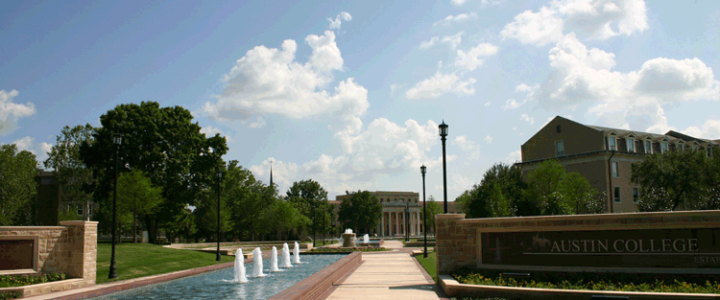

Austin College featured in Princeton Review

Austin College featured in Princeton Review

Austin College featured in Princeton ReviewSherman, Texas | August 31, 2016

Austin College is one of the nation’s best institutions for undergraduate education, according to The Princeton Review. The education services company features the school in the new 2017 edition of its college guide, The Best 381 Colleges. In addition, Austin College is included in the book’s rankings of Best in the Western Region and in Green Colleges.

Only about 15 percent of America’s 2,500 four-year colleges are profiled in the book. Published annually since 1992, the guidebook includes detailed profiles of the colleges with rating scores for all schools in eight categories: academics, admission selectivity, financial aid, fire safety, and green, a measure of school’s commitment to the sustainability and the environment in its policies, practices and education programs.

Outstanding academics are the chief reason we chose schools for this book and we strongly recommend the schools to applicants,” says Robert Franek, Princeton Review’s senior vice president, publisher, and author of The Best 381 Colleges. “We make our selections primarily based on data we collect through our annual surveys of administrators at several hundred four-year colleges, Franek said. “Additionally, we give considerable weight to observations from our school visits opinions of our staff and our 24-member National College Counselor Advisory Board, and an unparalleled amount of feedback we get from our surveys of students attending these schools. We also keep a wide representation of colleges in the book by region, size, selectivity and character.”

The Princeton Review explains the basis for each ranking list at http://www.princetonreview.com/college-rankings/ranking-methodology.

Austin College, a private national liberal arts college located north of Dallas in Sherman, Texas, has earned a reputation for excellence in academic preparation, international study, pre-professional foundations, leadership development, committed faculty, and hands-on, adventurous learning opportunities. One of 40 schools profiled in Loren Pope’s influential book Colleges That Change Lives, Austin College boasts a welcoming community that embraces diversity and individuality, with more than 40 percent of students representing ethnic minorities. A residential student body of approximately 1,275 students and a faculty of more than 100 allow a 13:1 student-faculty ratio and personalized attention. The College is related by covenant to the Presbyterian Church (USA) and cultivates an inclusive atmosphere that supports students’ faith journeys regardless of religious tradition. Founded in 1849, the College is the oldest institution of higher education in Texas operating under original name and charter.

Austin College Summer Solstice Watch

Austin College Summer Solstice Watch

Marking the Passage of Time

Austin College Summer Solstice WatchAustin College| Sherman Texas

Faculty and staff of Austin College will gather Monday, June 20, in the College’s IDEA Center to mark the Summer Solstice as they watch the progression of the Sun through the building’s solstice calendar. As the light from the Sun travels along the floor the center the group will welcome the Summer Solstice at 1:28 p.m. Members of the community are invited to the free event, which begins at 1:15 p.m. in the Oscar Page Atrium of the IDEA Center.

Austin College’s IDEA Center solar observatory marks the location of the Sun at local “high” noon, a few hours before the precise solstice at 5:34 p.m., explained Dr. David Baker, Austin College professor of physics. “Sherman solar enthusiasts need not worry,” he said. “The beam of sunlight in the IDEA Center atrium will be ‘spot on’ as it hits the summer solstice marker, the Macedonian symbol for the Sun.”

Dr. David Baker, professor of physics, will explain the progress of the solstice as it occurs. “This event gives us a sense of progress,” said Baker. “We don’t pay attention to the Earth’s rotation in our everyday lives, but the Earth keeps on moving.” Watching the sunlight align with the Earth is a truly fantastic experience for Dr. Baker. “Within seconds, the sunlight is there and gone,” he said. “It’s mesmerizing, almost magical.”

Summer solstice occurs when the Sun reaches the northernmost limit in its path in the sky, Baker explained, adding that solstice means “Sun-stopping.” Between spring equinox and summer solstice, the Sun moves northward in the sky from the equator each day. At solstice, the Sun stops this northward movement, reverses direction, and begins heading south. The exact moment of this Sun-stoppage will be on June 20, at 5:34 p.m. CDT. The Sun will be directly overhead near the Hawaiian Islands at this time, Baker said.

The idea of a solstice calendar in the IDEA Center began with physics faculty member Dr. Don Salisbury. After visiting an unfinished solar observatory with students on a trip to Florence, Italy, during a January Term, he became inspired to propose a similar project for the soon-to-be-constructed IDEA Center. A few years ago when the building was constructed, students and faculty took precise measurements in order to properly place the gnomon hole opening in the building’s roof to let the sunlight into the atrium. The careful measurements also were used to inscribe the calendar markings into the terrazzo floor of the building. The IDEA Center solstice calendar pays homage to scientific contributions across the world; symbols of Western, Eastern, and indigenous cultures are represented.

Austin College, a private national liberal arts college located north of Dallas in Sherman, Texas, has earned a reputation for excellence in academic preparation, international study, pre-professional foundations, leadership development, committed faculty, and hands-on, adventurous learning opportunities. One of 40 schools profiled in Loren Pope’s influential book Colleges That Change Lives, Austin College boasts a welcoming community that embraces diversity and individuality, with more than 36 percent of students representing ethnic minorities. A residential student body of 1,250 students and a faculty of more than 100 allow a 12:1 student-faculty ratio and personalized attention. The College is related by covenant to the Presbyterian Church (USA) and cultivates an inclusive atmosphere that supports students’ faith journeys regardless of religious tradition. Founded in 1849, the College is the oldest institution of higher education in Texas operating under original name and charter.