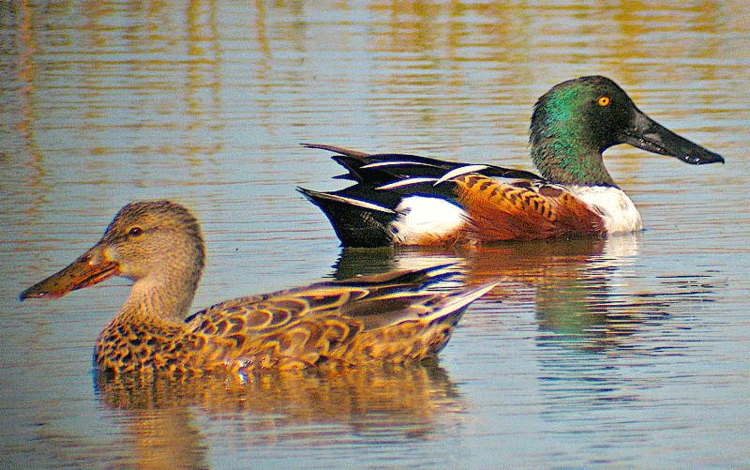
Artists wishing to participate in this year’s Oklahoma Waterfowl Stamp design competition have until 4:30 p.m. Aug. 31, 2017, to submit their artwork. The Northern Shoveler is this year’s selected subject for the prestigious contest that has been conducted annually since 1980 by the Oklahoma Department of Wildlife Conservation.
The winning artwork will serve as the design for the 2018-19 Oklahoma Waterfowl Stamp, which can be purchased by waterfowl hunters in the state and stamp collectors nationwide. The winning artist will receive a $1,200 purchase award courtesy of NatureWorks, a Tulsa-based conservation organization.
The state waterfowl hunting license is required to be carried by anyone hunting waterfowl in Oklahoma, unless exempt. The license costs $10 and will go on sale June 1, 2017, online at wildlifedepartment.com, in person at the Department’s temporary headquarters, or from hundreds of hunting license vendors across the state.
Any waterfowl hunting license buyer may request a physical stamp in person at the Wildlife Department’s temporary headquarters, 2145 N.E. 36th St. in Oklahoma City. Hours are 8 a.m. to 4:30 p.m. weekdays.
The Wildlife Department receives no general state tax appropriations, so revenue from waterfowl license/stamp sales is an important source of funding for in-the-field habitat work to benefit waterfowl and other wetlands wildlife. Since Oklahoma’s waterfowl stamp program began, about 12,000 acres of habitat has been purchased and many thousands of acres of habitat has been enhanced, restored and maintained for the benefit of waterfowl.
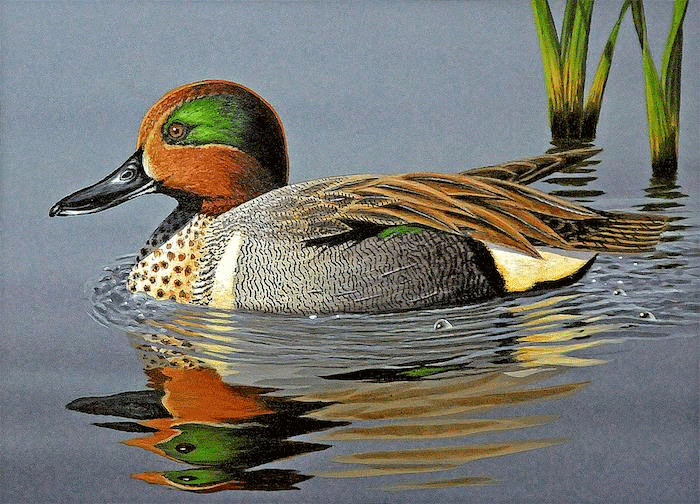
The 2017-18 Oklahoma Waterfowl Stamp will feature a green-winged teal in artwork created by Mark S. Anderson of Sioux Falls, S.D.
Contest entries must be original two-dimensional artworks rendered on a flat surface (not canvas) in acrylic, oil, watercolor, pencil, pen and ink, tempera or any other similar media. The artwork must be oriented horizontally and sized 6.5 inches high by 9 inches wide. Each artwork must be matted with white matboard with an outside measurement of 9 inches high by 12 inches wide. Artwork cannot be framed or under glass but can be protected by a removable covering such as acetate.
Voting by the public will take place online and count as part of the scoring. Department judges will then consider each artwork in terms of anatomical accuracy, artistic composition and suitability for printing. Any background habitat depicted must be typical of an Oklahoma locale.
Entries are limited to one artwork per artist, and a $20 nonrefundable entry fee is required. Mailed entries should be sent to Duck Stamp Competition Coordinator, Oklahoma Department of Wildlife Conservation, P.O. Box 53465, Oklahoma City, OK 73152. Ground deliveries should be made to 2100 N.E. 37th St., Oklahoma City, OK 73111.
While the Wildlife Department no longer produces prints of the winning artwork, a few limited-edition prints from previous years are still available for sale. To order, go to wildlifedepartment.com. Complete contest rules are online at wildlifedepartment.com/hunting/species/waterfowl/duck-stamp-program/rules. For more contest information, call (405) 521-4632. have until 4:30 p.m. Aug. 1, 2017, to submit their artwork.
 “Urban Dialog: Science After Dark”, returns on June 6, 2017, from 7pm to 8pm, and will feature a discussion on “Cloning and Bio-Ethics”. The event will be held at Grayson Hall, 113 S. Travis Street, in downtown Sherman’s Kelly Square. The event encourages attendees to discuss their opinions with each other and with subject matter experts in a friendly, social environment. Admission to the event is free with complimentary snacks and beverages provided courtesy of the Sherman Rotary Club. “Urban Dialog: Science After Dark” is a joint production of The Sherman Museum, Austin College, and the Sherman Rotary Club. Speakers will include Dr. Karánn Durland, Professor of Philosophy; Religious Studies Department Chair from Austin College, and Dr. John Richardson, Associate Professor of Biochemistry; Director of the STEM Teaching and Research Leadership Program from Austin College. Shawn Kirby of the Herald-Democrat will moderate the event.