
Grayson College Just for Fun Cooking Classes

Grayson College Just for Fun Cooking Classes

Grayson College Just for Fun Cooking ClassesGrayson College Just for Fun Cooking Classes Spring 2016

Grayson College just for fun cooking classes are under way for the spring semester. Desserts, steak and comfort foods are on the menu as Grayson College Hospitality Management & Culinary Arts Center partners with its Center for Workplace Learning to offer seven recreational cooking classes for adults and children alike. Open to the public, classes take place at the Culinary Arts Center on Grayson College’s Main Campus in Denison, east of the Viking Dorm. Participants must be at least 16 years old to enroll in the classes, except where noted.

Taught by Grayson College’s chef instructors and guest chefs, courses provide hands-on training, demonstrations, and interactive learning in the college’s state-of-the-art facility. Participants experience cuisines, explore cooking methods, and learn disciplines and knife skills as they prepare and consume cuisine that ranges from the familiar to the unexpected. In some of the classes, participants prepare goodies to take home as well.
“Knife Skills” is designed for beginners who want to hone their skills while preparing a delicious family favorite: breaded chicken tenderloins, sweet potato fries and ranch dressing. Tuition is $29 per person. Class meets Feb. 23 from 5:30 to 8:30 p.m.

“Steakhouse Favorites” offers tricks of the trade to cook a good steak to perfection. The menu features New York strip a la Oscar, roasted garlic whipped potatoes and grilled asparagus. Tuition is $39 per person. Class meets March 8 from 5 to 8 p.m.
“Easter Egg Dyeing Eggstravaganza” is a family-cooking class for children age 5 and above who are accompanied by an adult. Participants dye eggs in all kinds of colors and decorate with embellishments for fun and whimsy. Class meets March 26 from 10 to 11:30 a.m. Tuition is $14 and covers one adult and one child.

“Spring Pie Class” continues GC culinary arts’ ever-popular pie series. Participants learn to make two perfect pies (crust, filling and decoration): coconut cream and key lime. Tuition is $39 per person. Class meets March 26 from 1 to 4 p.m.

“Crazy Cupcakes” is a family-cooking class for children age 5 and above who are accompanied by an adult. Participants bake cupcakes and then improve their piping skills as they learn beautiful ways to decorate them. Class meets April 16 from 11:30 a.m. to 2:30 p.m. Tuition is $39 and covers one adult and one child.

“Cake Decorating: Buttercream” focuses on the various types of buttercream frosting, including American, Italian and Swiss. Participants take home their cake creations. Tuition is $39 per person. Class meets April 30 from 1 to 4 p.m.
“Comfort Food Favorites” features a classic menu that any southern cook would be proud to bring to the table. Buttermilk fried chicken, biscuits with whipped honey, and green bean casserole with fried onion strings are all made from scratch. Tuition is $29 per person. Class meets May 6 from 5:30 to 8 p.m.

In addition to the spring cooking classes, private cooking classes and children’s birthday cooking classes are available as well. For more information or to register for the spring recreational and private classes, visit the GC Center for Workplace Learning website at www.cwlgcc.org. Registration may be completed online at www.cwlgcc.org, in person weekdays from 8 a.m. to 4 p.m. in the CWL on the college’s Main Campus in Denison, or by phone at 903-463-8765 if paying with MasterCard, Discover or Visa credit cards.

Where Do Butterflies Go in Winter?

Where do Butterflies Go Swallowtail

Where Do Butterflies Go in Winter? by Laurie Sheppard

Winter can be tough on plants and animals. Some plants never come back after they freeze. Some birds migrate to warmer climates and others fluff up their downy feathers to keep warm. People hope that freezing will kill off insect pests like mosquitoes, but what about butterflies? When it gets cold we don’t see them. What happens to them?

Different species of butterflies use differing strategies to survive the winter season and repopulate the countryside in the spring – even in far northern climates. Some spend the winter in one of their other forms: egg, caterpillar, or chrysalis. Others hibernate or semi-hibernate. And some, like birds, escape the cold by migrating.

Monarch butterflies have been in the news recently because research has shown a dramatic drop in their numbers due at least in part to loss of habitat. As a result, many people are aware of the Monarch’s annual migration to the mountains in Mexico where they gather by the thousands to escape the cold. Humans are helping by planting Milkweed for the Monarchs to feed on during their journey.

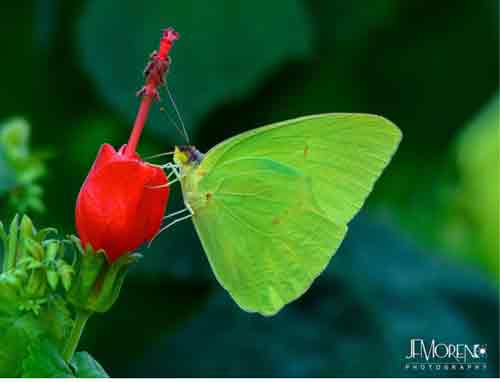
Butterfly on Turks CapButterfly migration is truly amazing when you think about the life span of any adult butterfly. Most live in that form for only a few months and none lives a full year on the wing. The Monarchs who make the trip south are not the same generation that made the trip the year before, yet they know instinctively what to do and where to go. But Monarchs are not the only butterflies that migrate. Several species seen at the refuge are also migratory. Resident butterflies seen in larger numbers in fall may have been joined by their northern cousins passing through on the way south. Migrators include the large yellow Cloudless Sulphurs (shown in photo at right, by Jesus Moreno) that visit the Turk’s Cap in the garden, or Queens, that love the Gregg’s Mistflower blooming in fall. Painted Lady and American Lady are not coldhardy and also migrate, as well as other fragile but longer-lived butterflies.

One unique characteristic of butterfly species that do not migrate from colder climates is that the cells of at least one life stage are resistant to freezing. In whichever stage overwinters, there is an abundance of small molecules such as glycerol that prevent the egg, caterpillar, or butterfly from developing ice crystals when the temperature drops. North Texas rarely has more than brief freezes, but even in northern states and Canada, many butterfly species survive harsh winters and abundant snow and ice because of this natural anti-freeze.

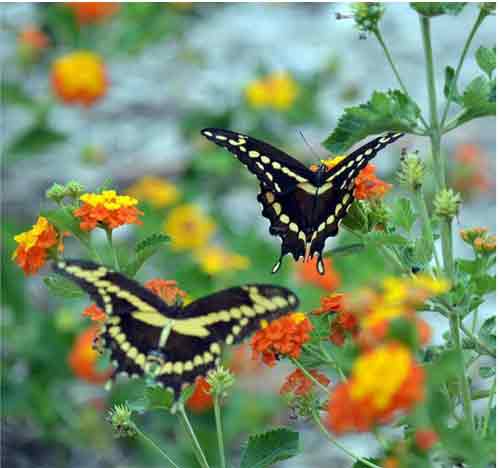
Butterfly eggs laid on leaves of larval food sources will remain in leaf litter on the ground until the warming sun signals the time to hatch, which typically coincides with the emergence of the host plant’s new leaves. In woodsy areas of the refuge, this includes Henry’s Elfin and Falcate Orangetip, which have only one short-lived brood per year. In or near the garden, butterflies that winter as caterpillars include Eastern Tailed-blue and Little Wood-satyr. These mature into butterflies a little later in spring and can be found throughout most of the summer. Look for the Eastern Tailed-blue visiting Frog Fruit. Eastern Tiger Swallowtails and Black Swallowtails spend winter at the refuge as a chrysalis and emerge in early spring as mature butterflies that can be found feeding on Henbit and other spring flowers. (Giant Swallowtails, by David Colt, shown at left)

Where do Butterflies Go SwallowtailHibernators and semi-hibernators make up most of the butterflies we see on sunny winter days or in early spring at the refuge. They survive tucked into a sheltered crevice in a tree or wedged behind loose bark or burrowed into thick leaf litter, protected from ice or snow. Dainty Sulphur and Little Yellow are the smallest butterflies in the Sulphur family and both semi-hibernate at Hagerman. These can be seen regularly when the garden blooms, feeding on a variety of smaller flowers. The hibernating winter form of Question Mark butterflies have unique coloring on their hind wing and can live for several months. They occasionally emerge on warm winter days and mate once the risk of frost is over.

We think of butterflies as being with us only in summer, and certainly their numbers are highest then, when flowering vegetation is at its peak. However, there isn’t a month in the calendar that you cannot see at least one species of butterfly on the refuge if you look hard enough.

This article was first published on Friends of Hagerman Newsletter

TREASURE ISLAND

Treasure Island Theatrick'sTheatricks’ presents Treasure Island

Theatricks’ teen theatre group, the Supporting Cast, has prepared their production of TREASURE ISLAND which is opening Thursday, January 28 at 7 p.m. in the Honey McGee Playhouse and also plays January 29 and 30 at 7 p.m.

Robert Louis Stevenson’s.”coming of age” adventure about pirates and treasure hunting was originally serialized in the children’s magazine Young Folks between 1881 and 1882. It was first published as a book in 1883. It is one of the most frequently dramatized of all novels and has created in the imaginative minds of many young readers just what the characters and life of an adventurous pirate might be like. This play version of TREASURE ISLAND was adapted by former Supporting Cast member Austin Tooley in 2005.

“This production and the Supporting Cast program has been an adventurous process in itself that began in 1993 when the Theatricks Advisory Council first created the Supporting Cast as an outlet for teens 6th through 12th grade to learn and apply their knowledge of the theatre arts,” states Theatricks Director Webster Crocker. Twenty of the current Supporting Cast members have taken advantage of this theatre opportunity over the past few months and have cast, directed, designed and constructed set, lights, sound, costumes, makeup, and advertising to produce TREASURE ISLAND this weekend.

“I am truly thankful to the Sherman Community Players Board of Directors for so graciously approving the Supporting Cast’s production of TREASURE ISLAND, it is truly the culmination of everything that the Theatricks program has been trying to achieve for the children in our community since I first became a part of SCP in 1989,” says Webster Crocker.

The Supporting Cast’s TREASURE ISLAND is not just a production, but more of an event. There will be prizes awarded to those audience members who dress up as a pirate, as well as a treasure hunt game and Pirate Kits are on hand for those who really want the full theatre experience.

TREASURE ISLAND is sponsored by the Compass Rose, a replica of an 1800’s wooden brigantine ship that is docked on Lake Texoma. Tickets to see TREASURE ISLAND at the Honey McGee Playhouse are $5.00 and can be purchased and reserved online at www.theatricks.org or at the door the night of the show. Seating is limited, so don’t wait too long to come join the Supporting Cast crew this Thursday