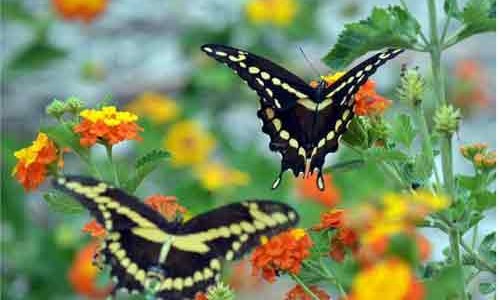
Where Do Butterflies Go in Winter? by Laurie Sheppard
Winter can be tough on plants and animals. Some plants never come back after they freeze. Some birds migrate to warmer climates and others fluff up their downy feathers to keep warm. People hope that freezing will kill off insect pests like mosquitoes, but what about butterflies? When it gets cold we don’t see them. What happens to them?
Different species of butterflies use differing strategies to survive the winter season and repopulate the countryside in the spring – even in far northern climates. Some spend the winter in one of their other forms: egg, caterpillar, or chrysalis. Others hibernate or semi-hibernate. And some, like birds, escape the cold by migrating.
Monarch butterflies have been in the news recently because research has shown a dramatic drop in their numbers due at least in part to loss of habitat. As a result, many people are aware of the Monarch’s annual migration to the mountains in Mexico where they gather by the thousands to escape the cold. Humans are helping by planting Milkweed for the Monarchs to feed on during their journey.
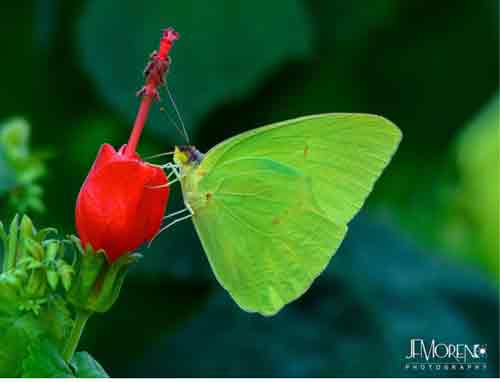 Butterfly migration is truly amazing when you think about the life span of any adult butterfly. Most live in that form for only a few months and none lives a full year on the wing. The Monarchs who make the trip south are not the same generation that made the trip the year before, yet they know instinctively what to do and where to go. But Monarchs are not the only butterflies that migrate. Several species seen at the refuge are also migratory. Resident butterflies seen in larger numbers in fall may have been joined by their northern cousins passing through on the way south. Migrators include the large yellow Cloudless Sulphurs (shown in photo at right, by Jesus Moreno) that visit the Turk’s Cap in the garden, or Queens, that love the Gregg’s Mistflower blooming in fall. Painted Lady and American Lady are not coldhardy and also migrate, as well as other fragile but longer-lived butterflies.
One unique characteristic of butterfly species that do not migrate from colder climates is that the cells of at least one life stage are resistant to freezing. In whichever stage overwinters, there is an abundance of small molecules such as glycerol that prevent the egg, caterpillar, or butterfly from developing ice crystals when the temperature drops. North Texas rarely has more than brief freezes, but even in northern states and Canada, many butterfly species survive harsh winters and abundant snow and ice because of this natural anti-freeze.
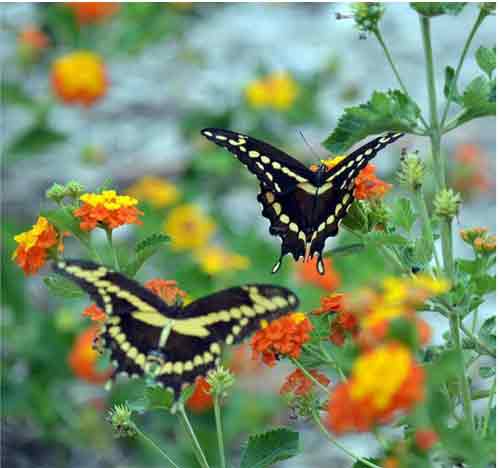
Butterfly eggs laid on leaves of larval food sources will remain in leaf litter on the ground until the warming sun signals the time to hatch, which typically coincides with the emergence of the host plant’s new leaves. In woodsy areas of the refuge, this includes Henry’s Elfin and Falcate Orangetip, which have only one short-lived brood per year. In or near the garden, butterflies that winter as caterpillars include Eastern Tailed-blue and Little Wood-satyr. These mature into butterflies a little later in spring and can be found throughout most of the summer. Look for the Eastern Tailed-blue visiting Frog Fruit. Eastern Tiger Swallowtails and Black Swallowtails spend winter at the refuge as a chrysalis and emerge in early spring as mature butterflies that can be found feeding on Henbit and other spring flowers. (Giant Swallowtails, by David Colt, shown at left)
 Hibernators and semi-hibernators make up most of the butterflies we see on sunny winter days or in early spring at the refuge. They survive tucked into a sheltered crevice in a tree or wedged behind loose bark or burrowed into thick leaf litter, protected from ice or snow. Dainty Sulphur and Little Yellow are the smallest butterflies in the Sulphur family and both semi-hibernate at Hagerman. These can be seen regularly when the garden blooms, feeding on a variety of smaller flowers. The hibernating winter form of Question Mark butterflies have unique coloring on their hind wing and can live for several months. They occasionally emerge on warm winter days and mate once the risk of frost is over.
We think of butterflies as being with us only in summer, and certainly their numbers are highest then, when flowering vegetation is at its peak. However, there isn’t a month in the calendar that you cannot see at least one species of butterfly on the refuge if you look hard enough.
This article was first published on Friends of Hagerman Newsletter
 Theatricks’ presents Treasure Island