Artists Combine Jewelry and Found Objects in Upcoming Austin College Exhibit
SHERMAN, Texas–Austin College alumnae artists Martina Noble of Sherman and Amy Veatch of Raleigh, North Carolina, explore how adornment and collection reveal and reflect the story of people’s lives in their upcoming exhibit, “Subliminal Surprises,” opening November 5 at Austin College.
The exhibit runs November 5 through December 14 in Ida Green Communication Center’s Ida Green Gallery. An artist reception is scheduled for Saturday, November 10, from 5:30 to 7:30 p.m. in the gallery in connection with Austin College’s Homecoming and Family Weekend. The exhibit and reception are free and open to the public. The gallery is open weekdays from 9 a.m. to 4 p.m.
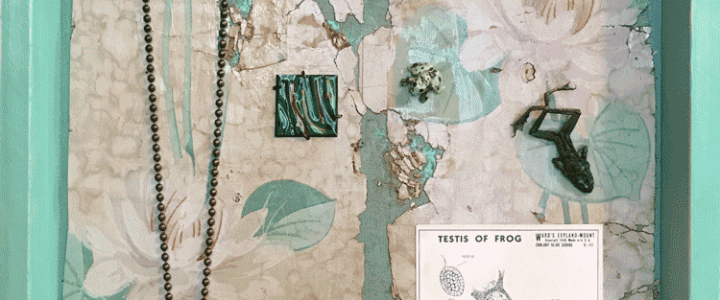
In the exhibit, “Subliminal Surprises,” jewelry and other found and saved objects explore the markers people leave behind as they link the present with the experiences of the past, the artists say. In the exhibit, the artists present a series of assemblage pieces, each featuring an item of jewelry, surround the jewelry with a suite of other objects, found or saved, that create a context which whispers, sings, or silently points up something of the artists’ thought process, Noble said. The jewelry, she explained, tells a story as it is included with other treasures, such as a small snake skeleton, a piece of wallpaper from an old house, and biology slides from a closed laboratory.
“Through various objects, treasures, and traces of other stories, other times, the pieces delineate the meandering arc of a lifetime, and its many intersections with other lives,” Veatch said. “This show explores the topography of time, beauty, and sublimity. It looks at what we hold as precious, ordinary, and extraordinary. It asks what do we see, what do we keep, what do we leave behind? And what surprises arise as we plumb these layers of experience?”
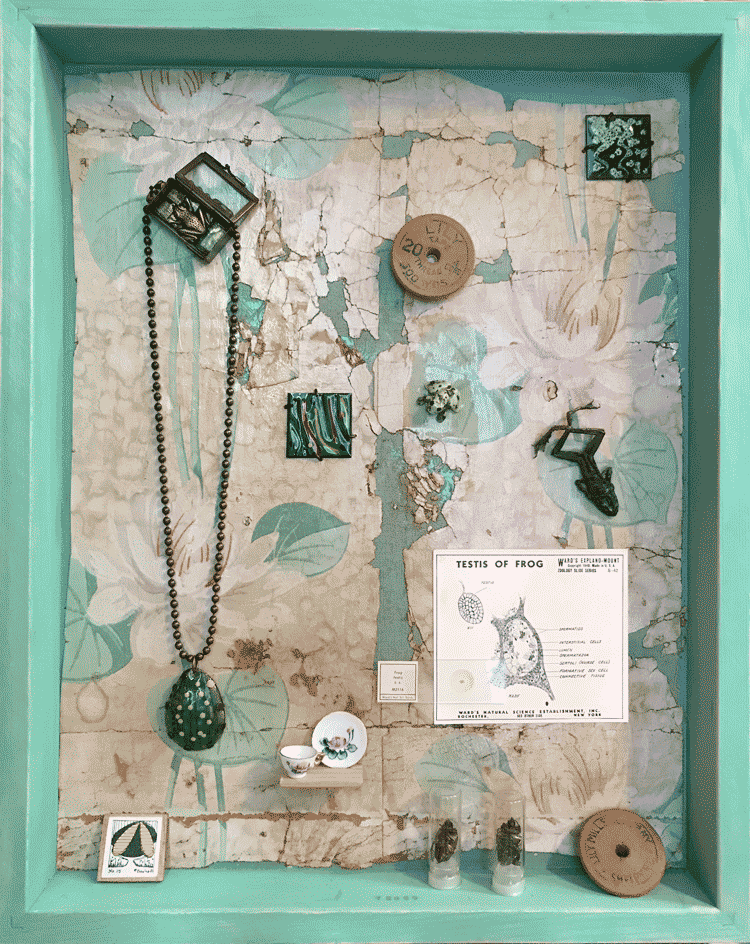
In their artists’ notes, Veatch and Noble explain, “This context shows how jewelry and other objects, such as wallpaper, fill some need to adorn our lives and explain ourselves. We investigate the idea that a house is decorated or adorned, and life happens all around the adornment: nesting, birth, daily drudgery, celebrations, sadness, innovation, learning, illness, death, and the myriad decisions of a lifetime. We adorn ourselves with jewelry and keepsakes from our past, our family, our present day; and we adorn our houses with ‘jewelry’ of a sort with decorative elements and furnishings. We live our lives in this mix of declaration of self, family, culture, and society … all marked with the adornment that reveals our journey.”
About the Artists
 Amy Veatch, Austin College Class of 1985
Amy Veatch has set a personal goal to notice and find worth in materials or objects that are used in everyday life and mix materials to create art that reflects life and its relationships. She makes jewelry from precious and non-ferrous metal sheet, tube and wire, found objects and stones, incorporating all of her interests in two-dimensional and three-dimensional artistic expression.
Growing up in Tulsa, Oklahoma, Veatch said she loved experimenting and creating art in many forms and found inspiration in the jewelry made by Native American and Mexican artists. She still loves the natural materials used in that jewelry and how it reflects landscape and architectural shapes.
As an art major at Austin College, she concentrated on painting, drawing, and sculpture, and began to incorporate metals into her work. After moving to Raleigh, North Carolina, she enrolled in a jewelry program and expanded her art. Her recent work includes an award-winning mural for Raleigh Parks, Recreation, and Cultural Resources at the city’s Peach Road Park.
Veatch lives and works in North Carolina, where she teaches jewelry and art for the City of Raleigh and North Carolina State Crafts Center.
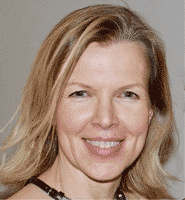 Martina Noble, 1985 Austin College graduate Martina Buesing
Martina Noble, the daughter of a Naval architect, grew up on the shipyards of the port town of Hamburg, Germany. Avid sailors, her family spent summer weekends on the Elbe River and the Baltic and the North seas. During the winters, they worked on their boat. Noble’s fascination with metal and the ocean sparked there. “Life on the water is simple, beautiful, and stark: sparkling sunlight and ferocious storms,” she said.
Jewelry is an ancient, intimate art form—worn on the body, making a statement, she said. Using, silver, gold, gemstones and found materials, Noble searches simple lines for “the essence of a shape or a concept: a rolling wave, a smile. At their essence life, people, and ideas intersect and celebrate commonality.”
Noble holds a Graduate Jeweler Diploma from the Revere Academy in San Francisco, a master’s degree in international relations and economics from the Paul Nitze School of Advanced International Relations at Johns Hopkins University, and a bachelor’s degree in political science from Austin College. She lives and works out of an old fire station in Sherman.
Austin College, a private national liberal arts college located north of Dallas in Sherman, Texas, has earned a reputation for excellence in academic preparation, international study, pre-professional foundations, leadership development, committed faculty, and hands-on, adventurous learning opportunities. One of 40 schools profiled in Loren Pope’s influential book Colleges That Change Lives, Austin College boasts a welcoming community that embraces diversity and individuality, with more than 40 percent of students representing ethnic minorities. A residential student body of approximately 1,275 students and a faculty of more than 100 allow a 13:1 student-faculty ratio and personalized attention. The college is related by covenant to the Presbyterian Church (USA) and cultivates an inclusive atmosphere that supports students’ faith journeys regardless of religious tradition. Founded in 1849, the college is the oldest institution of higher education in Texas operating under original name and charter.

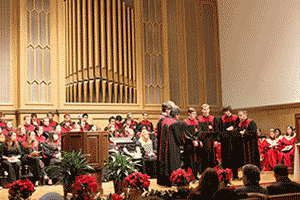 The College’s Religious Life program and the Department of Music will present a program of choral and orchestral selections from Handel’s “Messiah,” along with readings of Old Testament messianic prophesies and New Testament advent and Christmas scripture.