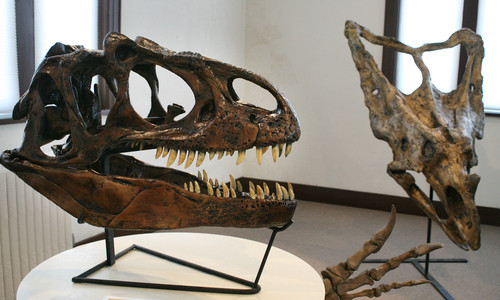
The Sherman Museum will be closed the week of Memorial Day from May 29th through June 2nd to both observe the Memorial Day holiday and to set up for this upcoming Summer’s Dino Days 2018. Construction of the fossil cast skeletons, including the 40-foot long, Ivan the Tyrannosaurus Rex, and a 20-foot long Triceratops, will be begin on Saturday June 2nd.
Dino Days officially begins on Wednesday, June 6th from 10am to 4pm Wednesday through Saturdays. Admission for Dino Days will be $5 for everyone, except for children under the age of five, who receive free admission.
“Dino Days is a very exciting time for us at the museum and for the community,” Assistant Director Brandon Young stated. “It is an amazing experience watching kids’ faces light up when they see the Tyrannosaurus Rex and the other dinosaurs.” There will be events throughout the summer including the Dino Academy, Nights at the Museum, and others.
About The Sherman Museum
The Sherman Museum is a non-profit 501(c) (3) educational organization devoted to collecting, preserving and interpreting objects of historical significance for visitors and residents of Grayson County and the Greater North Texas Region. The museum was previously known as The Red River Historical Museum prior to a name change in March 2011.
For more information about The Sherman Museum contact us at www.theshermanmuseum.org.
There is no better time to introduce your friends or family members to the great American pastime of fishing than to take them out on Free Fishing Days!
Anyone can fish for free June 2-3, 2018, in Oklahoma. On that weekend, a state fishing license will not be required for any resident or nonresident angler to fish.
The Sooner State has some excellent fishing in lakes, ponds, rivers and streams, but also in urban waters designated by the Oklahoma Department of Wildlife Conservation as “Close to Home Fishing” locations.
Although state fishing licenses and the Oklahoma City fishing permit (where applicable) are not required during Free Fishing Days, anglers should note that certain city permits may still apply in other urban fishing areas. Additionally, anglers fishing Lake Texoma should be aware that Free Fishing Days applies for all of the lake on June 2 but only on Oklahoma portions of the lake on June 3.
Oklahoma was the first state in the nation to offer free fishing days about 35 years ago and has since been followed by dozens of other states that have established similar days..
by the Oklahoma Department of Wildlife Conservation
The best thing you can do for young wildlife is to keep young wildlife wild.
Springtime is when people in the Lake Texoma area begin to see a variety of newborn and young animals. Newborn rabbits, squirrels, deer and birds easily appeal to most people’s sense of care and compassion. People often think these baby animals are “so cute” and imagine that they must be lost or abandoned.
Usually that is not the case.
“Chances are an adult animal is nearby and is simply waiting on you to move away so they can take care of their young,” said Mark Howery, natural resource biologist with the Oklahoma Department of Wildlife Conservation.
In most cases, people should not interfere with young wildlife.
In Oklahoma, most fawns are born in May and June. And that’s when people begin seeing the young animals.
Fawns are periodically left alone, which is normal behavior for the doe. People who come across young wildlife are urged to leave the animals alone. (Matt Johnston/RPS 2016)
Game Warden Brayden Hicks, based in Caddo County, said he has taken several calls from the public asking him to rescue a fawn found near a home. “I tell them don’t touch the fawn, and don’t try to feed it. Normally the momma is around, and she’s left her fawn on purpose so she can go feed.”
The doe leaves the fawn because it must maintain good nutrition to produce milk. Also, the doe will often leave a fawn in a safe place, such as near a house or where people can easily see them, because those are places where predators might be less likely to visit.
Also, the doe will stay away from its fawn so the doe’s scent will not attract predators. But the doe will normally return several times during the day to nurse its fawn.
Howery said springtime storms can easily blow young birds and squirrels out of their nests. Even though they may appear to be alone and distressed or in need of help, a mature animal will often find and care for them.
It can actually be more stressful on young wildlife when people try to help. People who take in wildlife and attempt to raise and release those animals are actually doing them no favors. The animals will lose their instinctual fear of people and begin to bond with and depend on people to survive. If returned to nature later, these animals will have no idea how to feed or what dangers to avoid. And the young animal could even die from the stress of being handled.
“It’s admirable when well-meaning Lake Texoma sportsmen and outdoor enthusiasts want to help, but sometimes the best help we can offer young wildlife is to leave them alone and let nature run its course,” Howery said.
In rare cases, an animal might actually need help, such as when it is injured or seriously ill. That is when the public might choose to call a wildlife rehabilitator. A list of rehabilitators by county is at www.wildlifedepartment.com/law/rehabilitator-list.