Lake Texoma Fall Fishing Report

Lake Texoma Fall Fishing Report

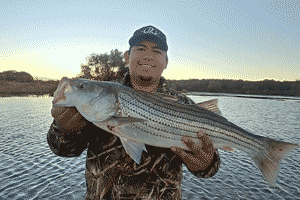
As a fishing guide, it is my job to observe nature. To be aware of the patterns, how they change, how they repeat and yet are never the same. Right now it is fall and we have had plentiful rainfall for the season so the elevation of the lake is a bit higher than normal which changes the landscape of the lake. Grasses and shrubs are submerged in water creating new ecosystems for all types of life as well as new terrain to explore. We have been seeing a lot of egrets, waterfowl and eagles. I’ve been watching an osprey that stays around one of our fishing spots, I often see her dive and catch fish and occasionally we will venture near her tree and she will cry out as if to say hello. The flooded vegetation also provides cover for small fish which attracts the larger fish and they attract fishermen. In the fall, some of the larger stripers will congregate in the shallows to enjoy the cooler temperatures and they are also attracted to the vegetation. This makes for an excellent opportunity for topwater fishing, some of the most exciting fishing of the year. Typically we are blind casting up into the shallows where I think the fish may be and often times, if the fish are there, they will explode on the lure on the first cast. This may last all day if it is cloudy and rainy but if the sun is out, the fish will move out into deeper water after the first hour or so of daylight. The fish on topwater are mostly over 20” so we are not able to keep many of them but they are certainly fun. We mainly use pencil poppers but swim baits like sassy shad work good as well. To catch our smaller fish we have been using bait, though some are doing well using slabs too. Fishing on anchor with live bait in 25-40 ft of water has been working well for us and we have been consistently bringing home our limit on most days.
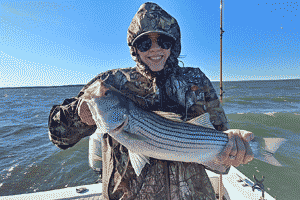
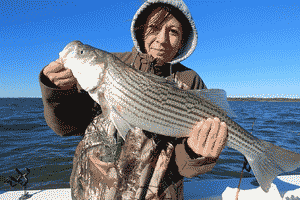
So far, we’ve had a good season fishing topwaters and there are still a couple of weeks left depending on how the fish respond to the weather. Usually it will last through the first week in November then we begin following the birds and casting sassy shad. We have some cooler weather approaching and I’m anticipating that the seagulls and loons will begin to arrive soon. It is a neat experience to join in a feeding frenzy with bird, fish, and man together as one. We usually follow the birds like this consistently from November through the end of December and will provide some of the best fishing of the year. Then around January as the water temperatures fall, the pattern shifts again and they change from roaming the lake in search of prey to holding stationary to structure where they feel comfortable. Catching fish in this pattern is a little more like bass fishing as we are targeting this structure all over the lake, moving from spot to spot and fishing with sassy shad swim baits. This is a reliable pattern which will typically yield some of our largest fish of the year.

Though the summer is fun and exciting, I really enjoy being on the water during the fall and winter months the most. Everything seems to settle down and the lake becomes more peaceful. It is not uncommon to have a trip during the week where you are one of the only boats on the lake. We will catch fish all winter long and right now, we have an abundance of fish in the lake right now so I’m anticipating a lot of fun to be had in the coming months for the foreseeable future. The holiday seasons are just around the corner and it is time to plan a trip to get out on the water with your family and friends while they are in town. Making memories with the people you love out on the water is what it is about, it is just a bonus that we get to bring home a cooler full of fish at the end of the day.

To find our more information, check availability and book your trip, visit our website www.stripersinc.com or give us a call at (903)815-1609.

Your Lake Texoma Striper Fishing Guide,
Brian Prichard
Stripers Inc.
www.stripersinc.com
(903)815-1609

Hagerman Adopt-a-Nestbox program helps Bluebirds

Adopt-a-Nestbox program

By Wes Crawford, Friends of Hagerman National Wildlife Refuge

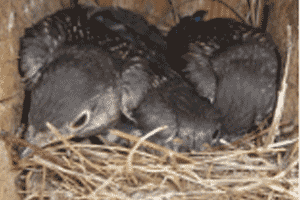
The Adopt-a-Nestbox program is a well-established volunteer activity of the Friends Of Haggerman.  In 2018,  31 volunteers monitored 52 nestboxes and some also helped with trail maintenance.  Due to these efforts, at least 200 birds safely fledged from our monitored nestboxes, including 148 Eastern Bluebirds, up from last year.

The Adopt-a-Nestbox program will begin again  on December 1st, when twenty of the refuge’s nestboxes will go up for adoption for a fee of $35. Those who adopt a box will be able to follow all the exciting happenings in their nestbox via an emailed weekly report, complete with pictures and information about the stages of development of the birds and babies inhabiting it throughout the season. Funds from the adopted nestboxes go toward maintaining all of the nestboxes on the refuge.

NestboxesOur nestbox monitors had their first meeting in late February, when they paired up and selected the trails they preferred to monitor. Each week a pair of monitors carefully open each box and note observations on the Cornell NestWatch data sheet. A volunteer specialist enters the data into the Cornell database for scientific monitoring and research, and another volunteer emails the reports, with pictures, of each nestbox’s progress to its adoptive owner in the adopt-a-nestbox program. Though each nestbox is checked weekly, each pair of monitors activates monthly, on a rotating schedule.

We are excited about our 2019 season because we will be working with an OU researcher to use a nestbox camera to monitor one of our boxes. We hope to be able to generate a video image of the happenings frominside the box. The video will be available for educational use for programs at the Refuge.

If you enjoy being outdoors, care about helping wildlife and want to get to see some of the beauty at HNWR, the NESTBOX TEAM is for you. Join us by contacting us via the FOH website, friendsofhagerman.com/Contact.

We wish to thank our team members for their help:
Dick Malnory, Ken Neuhard, Steve Keller, John Brennan, Susan Knowles, Bert Garcia, Sue Raasch, Walter Bryant, Don Lawrence, Ken Hildebrand, Trey Crosthwaite, Jerry Reid, Enid Kasper, Sharon Barker, Bill Nance, Kathy Nance, Larry Vargus, Wayne Meyer, Donna Rogers, Nana Rylander, Sue Abernathy, Cathy Van Bebber, Jim Russell, Teresa Crawford, Patricia Crain, Gene and Nancy Cushion.

We also thank Dick Malnory for fabricating box panel repairs.  A new addition to our program this year was a mowing team that helped the staff keep Harris Creek and Raasch trails mowed and vegetation clear from around the nestboxes. Our team consisted of Bert Garcia, Larry Vargus,
Don Lawrence, Gene Cushion, Alan Bosma, Jay McCurley, Stephen Walker, and Mike Grubb.

Texas Dove Season looks bright for season opener Sept 1

Dove hunt

AUSTIN — Though Hurricane Harvey caused a significant drop in dove hunter effort and harvest numbers last year, the Texas Parks and Wildlife Department expects the 2018-19 season to be back to normal. In Texas terms, normal means exceptional.

Opening day of dove hunting is Saturday, Sept. 1 statewide. For the third consecutive year, Texas dove hunters can look forward to a liberal 90-day season and 15-bird daily bag limits.  In addition, hunters in Texas’ South Dove Zone have the opportunity to hunt every weekend in September thanks to the Special White-winged Dove Days Sept. 1, 2, 8, and 9, combined with a Sept. 14 zone opener, the earliest in half a century.  Though hunting hours are limited to afternoons during the Special White-winged Dove Days (noon-sunset), hunters in the southern portion of the state are now able to take advantage of the earlier dates in which the majority of dove harvest in Texas occurs.

Over 300,000 Texas hunters harvest nearly one third of the mourning doves taken nationwide each year, far more than any other state.  In recent years, an estimated 10 million doves are harvested in Texas annually.  While Texas supports breeding populations of over 34 million mourning and 10 million white-winged doves, those numbers swell during the fall when birds from northern latitudes funnel south.

“Texas is uniquely situated to catch a lot of migratory birds as they move through the central part of the continent.  Couple that with the fact that we are such a big state with diverse habitats, and it makes sense that we have such large numbers of doves,” said Owen Fitzsimmons, TPWD Dove Program Leader.

“Despite the dry conditions this summer, we had excellent production very early in the spring thanks to a mild winter and good rains in February and March, so there are a lot of birds around,” Fitzsimmons said.  “Unless we get significant rain in the next couple of weeks, hunters really need to key in on areas with water.  That’s where the birds will be concentrated.”

White-winged doves were historically found in the lower Rio Grande Valley, but they have rapidly expanded in numbers and distribution across Texas in recent years.  According to Fitzsimmons, white-wing populations continue to grow and are making up a larger percentage of daily bag limits state-wide.  White-wings are now found mostly in and around urban areas, providing hunting opportunity for those hunting just outside major cities and urban centers.

During the early two weekends for the Special White-winged Dove Days (in the South Zone), hunting is allowed only from noon to sunset and the daily bag limit is 15 birds, to include not more than two mourning doves and two white-tipped doves. During the general season in the South Zone, the aggregate bag limit is 15 with no more than two white-tipped doves.

Hunters are reminded that licenses went on sale Aug. 15 for the 2018-19 hunting seasons and can be purchased through the agency’s 28 law enforcement field offices, at more than 50 state parks and over 1,700 retailers across the state. Licenses may also be purchased online through the TPWD website or by phone at (800) 895-4248. Call center hours are Monday through Friday, 8 a.m. to 5 p.m. and there is a required $5 administrative fee for each phone or online transaction. The online transaction system is available 24/7.

Hunting and fishing regulations for the new season are available in the Outdoor Annual in print, online and on the Outdoor Annual mobile app. A limited number of Outdoor Annual booklets can be picked up at any of the 1,700 license retailers. A Spanish language version is also available online.

To get more information on Texas hunting and fishing throughout the year, sign up for free email updates by texting TPWD HUNT or TPWD FISH and your email address to 468-311 (ex. TPWD HUNT myemail@emailaddress.com).

In addition to a hunting license, anyone born after Sept. 1, 1971, must successfully complete a hunter education training course in order to hunt legally in Texas.  The TPWD Hunter Education certification is valid for life and is honored in all other states and provinces. More information about hunter education is available online. If you misplace your certification you can print a replacement online at no cost.

A Migratory Game Bird endorsement and Harvest Information Program (HIP) certification are also required to hunt dove. HIP certification involves a brief survey of previous year’s migratory bird hunting success and is conducted at the time licenses are purchased.

2018-19 Dove Season Calendar

North Zone: Sept. 1 – Nov. 4 and Dec. 21-Jan. 14, 2019.

Central Zone: Sept. 1 – Nov. 4 and Dec. 21-Jan. 14, 2019.

Special White-winged Dove Days (entire South Zone): Sept. 1-2, 8-9.

South Zone: Sept. 14 – Oct. 30 and Dec. 14 – Jan. 21, 2019.